
Why Environmental Law is the Fastest-Growing Career Path in 2026
The Ecological Shift in American Jurisprudence
The legal landscape of 2026 is no longer defined merely by digital transformation, but by ecological necessity. As climate change shifts from a theoretical threat to a tangible regulatory driver, the legal profession has witnessed a tectonic shift in specialization. Environmental law, once considered a niche practice for non-profit advocates, has surged to the forefront of the American legal market. From corporate boardrooms in New York to federal agencies in Washington D.C., the demand for legal experts who can navigate the complexities of sustainability, carbon credits, and green litigation has reached an all-time high.
For law students and early-career attorneys, this evolution presents both a massive opportunity and a rigorous academic challenge. Navigating the nuances of the Clean Air Act amendments or the latest SEC climate disclosure rules requires deep research and a sophisticated understanding of jurisprudence. Many students find that managing the sheer volume of case studies and policy analysis can be overwhelming, leading them to seek professional law assignment help to ensure their academic foundations are as robust as the legal precedents they study. This expert support allows future environmental lawyers to master complex regulatory frameworks without compromising their GPA during their JD programs.
1. The Regulatory Catalyst: Federal and State Mandates
The primary driver behind the 2026 boom in environmental law is the unprecedented wave of US federal regulations. Following the implementation of the Federal Green Infrastructure Act of 2025, corporations are now legally required to provide transparent ESG (Environmental, Social, and Governance) reports. These are not mere suggestions; they are enforceable mandates with significant litigation risks for non-compliance.
States like California and New York have pushed the envelope further, introducing “Net Zero Litigation” frameworks that allow citizens to sue private entities for climate-related damages. This has created a massive need for defense attorneys who can represent corporations, as well as plaintiff attorneys specializing in class-action environmental suits. According to the US Bureau of Labor Statistics (BLS), legal occupations within the environmental sector are projected to grow by 14% by the end of the decade, nearly triple the average growth rate for all other legal specializations.
2. The Rise of “Climate Tech” Jurisprudence
In 2026, the intersection of technology and law is where the most lucrative careers are forged. Carbon Capture and Storage (CCS) technology and hydrogen fuel cell implementation require an entirely new set of legal protocols. Attorneys are now tasked with drafting “Smart Environmental Contracts” that utilize blockchain to track carbon offsets across international borders.
This technical shift has changed the profile of the “ideal” law student. It is no longer enough to understand the law; one must understand the science behind the policy. Consequently, law schools have integrated STEM-heavy modules into their curricula. For students coming from a purely humanities background, these modules present a steep learning curve. The complexity of these interdisciplinary studies is a major reason why students often rely on academic experts to translate scientific data into legal arguments effectively.
3. Salary Trends and Market Demand in the US
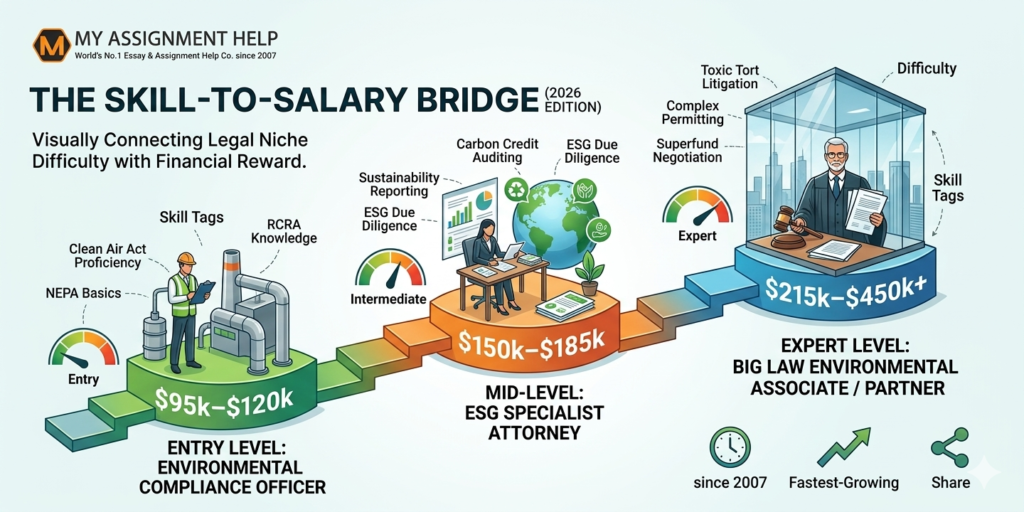
The economic incentive for entering environmental law has never been stronger. In 2026, the starting salary for an environmental associate at a “Big Law” firm in major hubs like Washington D.C., New York, or San Francisco ranges from $195,000 to $215,000. This reflects the high stakes of environmental litigation, where settlements often reach into the billions.
Demand is particularly high for experts in “Water Law” and “Toxic Tort” litigation. As drought conditions affect the American West and PFAS (“forever chemicals”) litigation continues to sweep through US courts, attorneys specializing in these areas are finding themselves in a “candidate-driven” market, often receiving multiple offers before they even pass the Bar Exam.
4. Career Strategy: Balancing Academics and Experience
The transition from a student to a high-earning environmental attorney requires more than just a passing grade; it requires a strategic approach to time management. In 2026, the most successful candidates are those who spend their final semesters networking with the EPA or clerkship directors rather than being buried under library stacks.
Because the workload in specialized legal modules has become so dense, many top-tier students strategically choose to pay someone to write my assignment when faced with non-core administrative tasks. This allows them to focus their energy on high-value activities like moot court competitions or specialized bar prep, which are ultimately what secure those six-figure starting salaries in the US region.
Key Takeaways
- Mandatory ESG: US-listed companies now require full-time legal teams for environmental compliance.
- Tech-Legal Hybrid: Knowledge of carbon credits and “Green Tech” is the most valuable skill in 2026.
- Geographic Hotspots: California and Texas remain the largest markets for environmental litigation.
Frequently Asked Questions (FAQ)
Q: Which US states have the highest demand for environmental lawyers?
A: California, Texas, New York, and Florida lead the market due to their unique environmental challenges, ranging from wildfire litigation to energy sector regulations.
Q: Can I transition from corporate law to environmental law?
A: Yes. Many firms are currently retraining corporate associates in ESG compliance to meet the 2026 regulatory surge.
Author Bio:
Jonathan Sterling is a Senior Content Strategist at MyAssignmentHelp. With over 12 years of experience in US academic support and legal content strategy, he specializes in creating high-authority resources that follow strict E-E-A-T guidelines. His work focuses on helping students across the US and Canada achieve academic excellence in the evolving legal sector.
References:
- US Bureau of Labor Statistics (BLS) – 2026 Legal Occupational Outlook.
- Environmental Protection Agency (EPA) – 2026 Strategic Plan for Regulatory Compliance.
- American Bar Association (ABA) – Section of Environment, Energy, and Resources (SEER) 2025 Annual Report.